

The European market is moving product compliance beyond “submitting a carbon report” toward the continuous provision of verifiable, updateable and interoperable environmental product data. That is why Product Environmental Footprint (PEF) and the Digital Product Passport (DPP) need to be addressed together.
PEF is not limited to carbon. Under the EF 3.1 method, it covers 16 environmental impact categories and requires appropriate databases, category rules, data-quality controls and modelling expertise. A DPP is also more than a QR code. It requires companies to transform information about materials, processes, origins, environmental performance and subsequent changes into a structured dataset that can be exchanged and maintained over time.
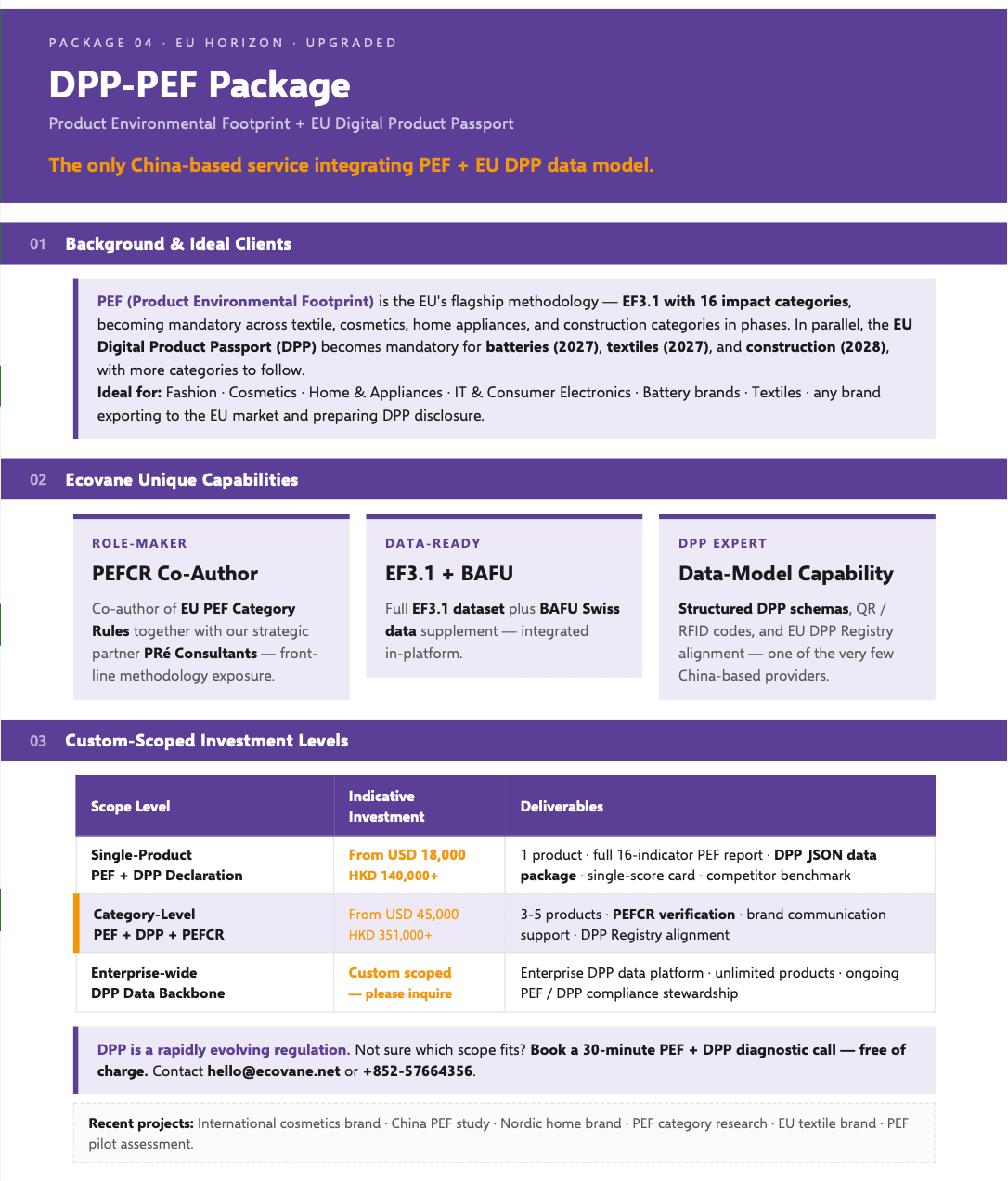
Package 04 | DPP–PEF Suite brings both requirements into one delivery pathway. It combines EcoVane’s methodology, database and DPP-model capabilities with Nanozeo and SSBTi’s supply-chain, field-upload and product-identification experience. The purpose is not merely to add another software function, but to help a company build an environmental-footprint and product-passport data architecture that can actually operate.
━━ Package 04 in One Sentence ━━
KEY POINT | From EF 3.1 multi-impact assessment and PEFCR category rules to DPP schemas, product identification and field-level supply-chain uploads, Package 04 establishes a data model that can be continuously updated, linked to physical products and used to support EU-market requirements.
Based on the current solution architecture, EcoVane and Nanozeo are among the relatively small number of Asian service teams able to combine PEF methodology, DPP data models, databases and field-level data connectivity within a single implementation pathway. The precise scope and timing of compliance must still be confirmed against the latest EU legislation, applicable product-category rules and customer requirements.
━━ 01 | Background, Target Users and Trigger Events ━━
▸ Why PEF and DPP Cannot Be Built Around Carbon Alone
A product carbon footprint focuses primarily on greenhouse-gas emissions. PEF evaluates a wider set of environmental impacts beyond climate change. A company that prepares only a carbon total will generally not have enough information to meet PEF’s multi-dimensional requirements or to populate the data fields needed for a continuously maintained DPP.
The purpose of a DPP is not to publish a static webpage or attach a QR code to a finished report. Product information must be capable of changing with materials, suppliers, production batches, manufacturing locations and regulatory requirements. In practical terms, PEF supplies the methodological foundation for environmental performance, while DPP organizes that information into a system that can be connected, exchanged and maintained.
▸ Target Users
• Fashion, textile and footwear brands;
• Cosmetics, personal-care and consumer-product companies;
• Home, appliance, IT and consumer-electronics brands;
• Battery and construction-product manufacturers preparing for the EU market;
• OEM and ODM suppliers responding to international customers’ PEF, DPP, material-origin or product-transparency requests;
• Corporate groups seeking to begin with representative products and then scale across SKUs, suppliers and markets.
▸ Typical Trigger Events
• An EU customer requests PEF, PEFCR or DPP-related information;
• A customer requests multiple environmental-impact results rather than carbon alone;
• A product category must follow specific rules, datasets or data-quality requirements;
• The company already uses LCA software but still needs to build PEF and DPP data structures and connections;
• Supply-chain information is fragmented across ERP systems, worksheets, supplier files and field records;
• The company wants to connect a physical product to environmental information through QR, NFC or RFID;
• Management is unsure whether to begin with one product, a product category or an enterprise data backbone.
━━ 02 | The Distinctive Capabilities of EcoVane and Nanozeo ━━
▸ 1. PEFCR Methodology Experience
EcoVane and its strategic partner PRé Consultants have participated in work related to EU Product Environmental Footprint Category Rules. This gives the team direct exposure to PEFCR methodology and enables it to begin with product category, functional unit, system boundary, allocation, data quality and impact-assessment requirements—before a model is built and results are calculated.
▸ 2. EF 3.1 and BAFU Multi-Dimensional Database Capability
Package 04 integrates the complete EF 3.1 dataset and supplements it with Swiss BAFU data. EF 3.1 supports 16 environmental impact categories, addressing the fact that PEF evaluates more than carbon. BAFU data can strengthen data selection for particular materials, processes and regional contexts.
The value of a database is not simply the number of datasets it contains. The real value lies in selecting information that matches the product category, geography, technology and quality requirements—and in retaining the database version, mapping rationale and traceability record.
▸ 3. Structured DPP Data Models
EcoVane incorporates structured DPP schemas, DPP JSON data packages, QR/RFID coding and Registry-alignment logic into the solution. Conventional LCA tools can calculate environmental impacts, but converting those results into a DPP still requires companies to design fields, identifiers, versions and update mechanisms.
Package 04 translates assessment results into data structures that a product passport can continue to use. This reduces the need for a second round of customized development after the PEF study has been completed.
▸ 4. Data Linkage and Field Uploads: Making the DPP Operational
The hardest part of a DPP is often not the first model. It is enabling suppliers and factories to continue providing reliable information afterward.
Nanozeo’s ZEOtext data-linkage mechanism can work with ZEOTags smart labels to connect environmental data with a physical product. QR, NFC or RFID identifiers can be used at product level, while participants at different supply-chain stages upload information through mobile devices. Raw-material receipt, manufacturing, transport, incoming inspection and subsequent updates can then form a connected and traceable data chain.
This capability is grounded in Nanozeo and SSBTi’s practical experience with international retail supply chains, product tags, LCA, Scope 3, CDP and supplier engagement. A DPP can therefore evolve from a one-time document into a continuously updated product passport.
▸ 5. Bridging the Gap Between the Model and the Physical Product
EcoVane provides PEF methodology, databases and DPP modelling. Nanozeo and SSBTi help validate the data logic among materials, processes, suppliers and buyers. Together, the teams bring methodology, database selection and field realities into one operating framework—reducing the risk of building a model that calculates correctly but cannot be maintained by the supply chain.
━━ LCA Calculation Capability Does Not Automatically Make a DPP Operational ━━
Professional LCA tools, including SimaPro, provide mature and reliable environmental-impact calculations. However, using PEF and DPP as a continuing product-compliance process normally requires additional work:
• Selecting and maintaining the applicable PEFCR and system boundary;
• Mapping EF 3.1 multi-impact data to the appropriate databases;
• Converting LCA results into structured DPP fields and JSON packages;
• Establishing unique product identifiers, version control and Registry-alignment logic;
• Enabling suppliers, factories and field teams to upload and update data;
• Reassessing model impacts when materials, suppliers or production batches change.
Package 04 integrates these tasks into a staged implementation pathway. A company does not need to coordinate separate providers for methodology, databases, software development, product identifiers and supply-chain data collection.
━━ 03 | Pricing: Three Implementation Levels ━━
▸ Essential | Single Product: PEF + DPP Declaration
From USD 18,000 / HKD 140,000
• One representative product;
• Full EF 3.1 PEF report covering 16 impact categories;
• DPP JSON data package;
• Product environmental-performance scorecard;
• Competitor or reference-scenario benchmarking;
• Suitable for companies that want to validate the methodology, data scope and customer acceptance through one product.
▸ Professional | Category Level: PEF + DPP + PEFCR
From USD 45,000 / HKD 351,000
• Three to five representative products;
• PEFCR conformity review;
• Product-category model and shared data rules;
• Brand communication support;
• DPP Registry alignment;
• Suitable for brands and manufacturers scaling from one product to a category and multiple SKUs.
▸ Enterprise | Corporate Flagship: DPP Data Backbone
Custom quotation
• Enterprise DPP data platform;
• Product volume defined according to the project scope;
• Connections to ERP, supply-chain systems, product identifiers and field uploads;
• Continuing PEF/DPP data maintenance and compliance operations;
• Suitable for corporate groups operating DPP across products, factories and suppliers.
These are indicative investment levels. Final pricing depends on product volume, category rules, data completeness, system connections, field requirements and the scope of any third-party verification.
━━ Selected Recent Commissioned Projects ━━
Recent PEF/DPP-related research and assessment work undertaken by the EcoVane team includes:
• International cosmetics brand: PEF research in China;
• Nordic home-furnishing brand: comparative PEF category study;
• EU textile brand: PEF pilot assessment.
To respect client confidentiality, only sectors and project types are identified here. These assignments demonstrate that the team works not only with platforms and databases, but also with the practical category-rule, data-acquisition, product-comparison and EU-communication challenges faced by different industries.
━━ How EcoVane, Nanozeo and SSBTi Work Together ━━
• EcoVane: PEF methodology, EF 3.1/BAFU data, structured DPP schemas, platform capabilities and consultant delivery;
• Nanozeo: corporate supply-chain practice, ZEOtext/ZEOTags product-data linkage, field uploads and international retail-buyer experience;
• SSBTi: supply-chain collaboration, definition of knowledge and methodology boundaries, disclosure-use alignment and membership-resource connections.
The goal is not merely to produce a PEF report or a DPP page. The teams first define an appropriate scope and build a verifiable data model, then scale it to product categories, suppliers and the enterprise data backbone.
━━ Next Step: Book a 30-Minute PEF + DPP Diagnostic Session ━━
DPP is a rapidly evolving regulatory and data environment. The most common question for companies is not whether they should prepare, but which product, system boundary and data structure they should begin with.
Before the diagnostic session, please prepare:
1. One key product and its target market;
2. The product BOM, principal materials, processes and supplier structure;
3. Any PEF, DPP or data-format request received from an EU customer;
4. A description of existing ERP, LCA, labelling or product-information systems;
5. Whether the initial objective is a single product, a category model or an enterprise platform.
During the 30-minute session, the team can make a preliminary assessment of the applicable PEFCR, data scope, database requirements, DPP model level and implementation pathway.
Contact: hello@ecovane.net; raymond@nanozeo.com
━━ Priority Benefits for SSBTi Supply-Chain Members ━━
Organizations joining SSBTi as supply-chain members may receive priority quotations and CJCHT group supply-chain discounts. Contact SSBTi / Nanozeo for a promotional code and a one-on-one initial consultation.
Clarifying the Roles of SBTi and SSBTi
In this solution package, SBTi refers to the Science Based Targets initiative, including the science-based target-setting framework and its associated formal validation mechanism for corporate climate targets.
SSBTi is the abbreviation for the Supply-chain Science Based Targets Institute, with its official website at SSBTi.org. Its registered legal entity in Taiwan is 「社團法人一點五度科學減碳倡議標準協會」.
Initiated in Asia by the CJCHT Group, SSBTi serves as a collaboration, review and implementation platform for supply-chain sustainability. It helps supply-chain companies coordinate emissions-reduction actions and make continued progress toward net-zero goals.
Its core role is to translate corporate climate commitments, international frameworks and customer requirements into actionable supplier tasks, training programs, data rules, reporting requirements and connected information systems.
SSBTi does not replace the formal SBTi target-validation mechanism, nor does it directly replace qualified independent assurance, verification or certification bodies. Instead, SSBTi works through its professional collaboration network, connecting professors, reviewers, verifiers and specialist organizations with relevant qualifications, methodological capabilities and industry experience.
Based on customer requirements, project scope and applicable standards, this network provides report review and technical assessment that connect data quality and methodology with practical supply-chain management.
The scope may include customer-required LCA reports, EPD documentation, ISO 14064-1 organizational GHG inventory reports, ISO 14067 product carbon-footprint reports, CBAM reports, CDP disclosures and SBTi target-related documentation.
Where a project requires a formal assurance statement, validation opinion, certificate or registered publication, the final output remains subject to the applicable scheme rules and must be performed or issued by an independent organization holding the required qualifications and authorization for that specific program.
SSBTi addresses the most difficult work that remains after corporate targets have been established and reports have been reviewed: supplier onboarding, data coordination, capability building, management integration and continuous improvement. Its role is to help companies transform one-time reporting outcomes into a supply-chain management system that can operate and improve over time.
For member companies, SSBTi.org also functions as a shared third-party coordination platform, connecting value-chain leaders, suppliers, advisors, technology providers, industry, government and academic stakeholders, and qualified verification bodies. This enables companies to build a collaborative supply-chain ecosystem around shared environmental and sustainability objectives more efficiently.