

When an OEM, Amazon, Walmart or an international brand asks a supplier for a product carbon footprint, the company does not merely need an internal calculation. It needs a report that the buyer can understand, review and use directly within its procurement, disclosure or supply-chain management process.
Package 03 | Product Carbon Footprint Suite is Ecovane's annual service package for this reality: short deadlines, multiple SKUs, defined buyer formats and traceable data. It combines product-category models, LCA and carbon-footprint methodology, data guidance, buyer-format conversion and consultant delivery capacity. Companies can begin with five SKUs and scale to portfolios of 30 products or more.
━━ Package 03 in One Sentence ━━
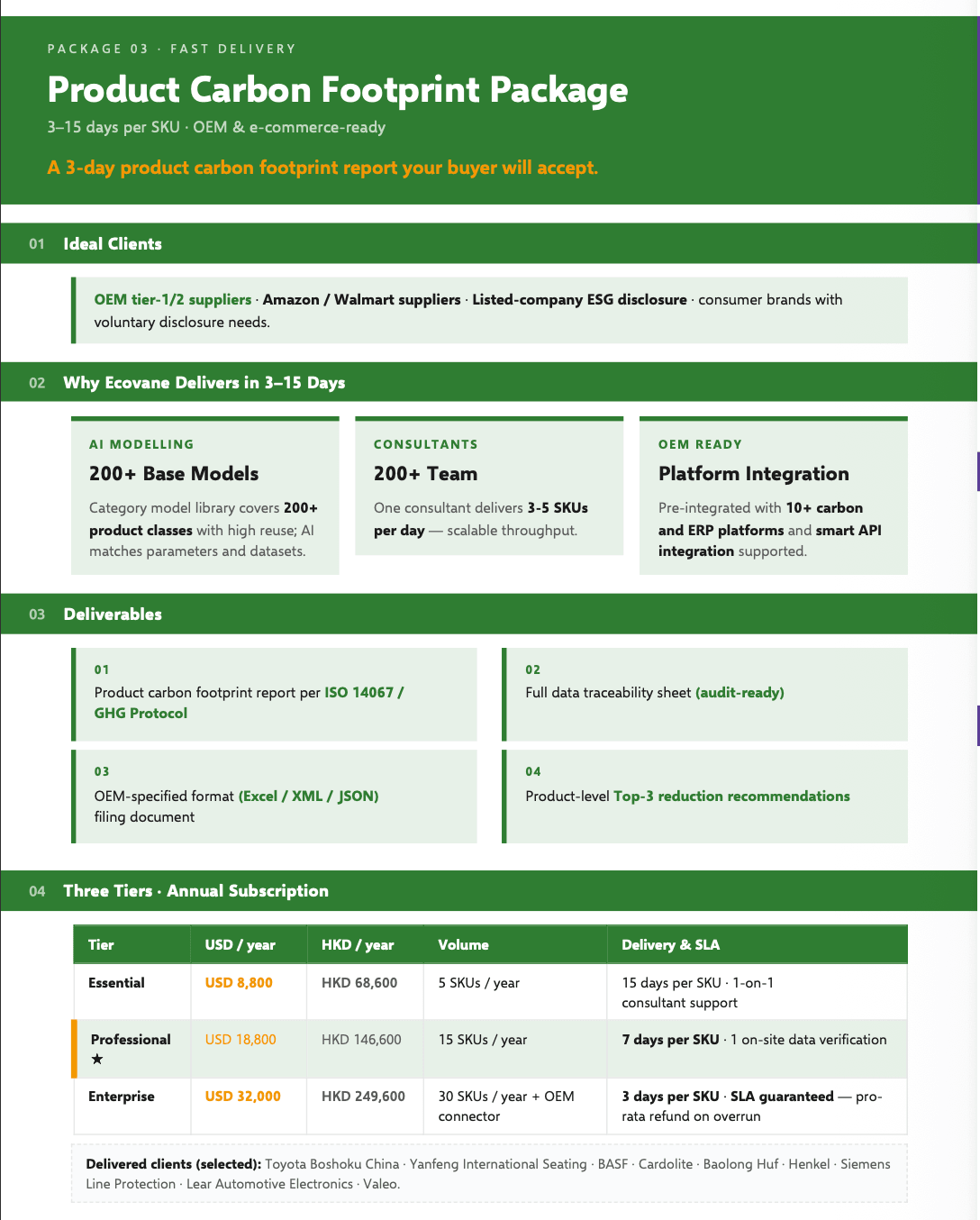
KEY POINT | A product carbon footprint report that buyers can use directly: depending on data completeness and the selected service level, each SKU can be delivered within 3–15 days; when the buyer format, system boundary and supporting data are already confirmed, a sample report can be produced in as little as three days.
“Buyer-ready” means that the report is organised according to the buyer's specified format, product boundary and data requirements, so it can enter the buyer's review, procurement or disclosure workflow. Final acceptance remains subject to the buyer's own rules and review outcome.
━━ 01 | Target Users and Typical Trigger Events ━━
▸ Target Users
• Tier 1 and Tier 2 OEM suppliers;
• suppliers serving Amazon, Walmart and other retail or e-commerce supply chains;
• listed companies that need ESG, Scope 3 or product-level disclosure;
• consumer brands with voluntary carbon-disclosure, green-procurement or customer-communication needs;
• manufacturers managing multiple products and seeking to replicate one methodology across many SKUs.
▸ Typical Trigger Events
• an OEM buyer requests product carbon footprints for multiple products within 30–60 days;
• a major retailer or brand requires suppliers to submit product data in a designated template;
• the customer will not accept a single total figure and asks for the material, process, transport and data-source basis;
• the company needs to connect product carbon footprint results with CDP, SBTi, Scope 3, green procurement or supply-chain decarbonisation;
• the same product data must be converted into Excel, XML, JSON or another OEM-specified format;
• the internal team lacks sufficient LCA capacity but must deliver multiple SKUs within a short period.
━━ 02 | Pain Points and Solutions ━━
▸ Pain Point 01 | Buyers Work in Days, but Traditional Projects Take Months
Traditional product carbon footprint projects often begin from zero: confirming the product boundary, functional unit, material mapping and emission factors. Rebuilding these elements for every SKU makes it difficult to meet buyer deadlines.
Solution: begin with an established product-category model, identify the product family, shared materials and common processes, and then adjust only the parameters that differ between SKUs. Repeated work becomes a reusable product model rather than a separate calculation for every item.
▸ Pain Point 02 | The Company Has Data but Cannot Demonstrate Where It Came From
BOMs, purchasing records, process sheets, energy data, loss rates, packaging and transport information are often distributed across different departments. A result may still fail buyer review if the underlying data cannot be traced.
Solution: build a complete traceability table linking source evidence, activity data, unit conversions, database mapping and final results. Each material figure has an identified source, owner and version record for internal review and subsequent verification.
▸ Pain Point 03 | The Report Is Finished, but It Is Not in the Buyer's Format
OEMs, retailers, e-commerce platforms and customer systems may use different fields, file structures and submission templates. A standard PDF alone can leave the supplier with another round of manual reformatting.
Solution: obtain the buyer's required format at project launch, then convert the completed product carbon footprint into Excel, XML, JSON or another designated file structure so that it can enter the buyer's review or system workflow.
▸ Pain Point 04 | Cost and Time Escalate as the Number of SKUs Increases
One product may be manageable through manual effort. At 15, 30 or more SKUs, however, projects can lose control of versions, parameters and data confirmation without a product-family structure and a standard delivery process.
Solution: use an annual subscription, product-family modelling and a defined consultant workflow. Shared information is confirmed once and reused, while SKU-specific differences and delivery schedules are managed separately.
━━ Why Can Ecovane Deliver Within 3–15 Days? ━━
▸ 1. More Than 200 Product-Category Base Models
According to the solution package materials, Ecovane's model library covers more than 200 product categories. A project can begin with the closest reference model and data structure, then adjust for the product's actual materials, processes, geography and transport conditions, reducing repeated model-building work.
▸ 2. A Scalable Team of More Than 200 Consultants
Ecovane has more than 200 full-time consultants. For standardised, clearly scoped batch projects, the package sets a delivery-capacity target of approximately three to five SKUs per consultant per day, with teams allocated according to project scale so that multiple products can move forward in parallel.
▸ 3. Pre-Integration with More Than 10 Carbon and ERP Platforms
The platform is pre-integrated with more than 10 carbon-management and ERP systems and supports API connections. Companies with structured BOM, ERP or supply-chain data can reduce repeated entry and format conversion.
▸ 4. Nanozeo and SSBTi Add Buyer and Supply-Chain Judgement
Speed cannot come from software alone. Nanozeo has long-standing experience with LCA, PCF, CDP, SBTi and Scope 3 programmes in retail supply chains involving organisations such as Walmart and Target, and understands how buyers use supplier data. SSBTi helps translate buyer requirements into product boundaries, data rules and supply-chain delivery tasks, reducing the risk of producing a report that cannot be used directly.
▸ What Do 3, 7 and 15 Days Mean?
• As little as 3 days: the buyer format is available; the system boundary and calculation rules are confirmed; the BOM, weight, processes, energy data and necessary evidence are complete; and the product fits a mature category model;
• approximately 7 days: some data cleaning, unit conversion, mapping or one on-site data review is required;
• approximately 15 days: a product model is being created for the first time, the data is fragmented, or additional supplier information and consultant guidance are required.
A three-day delivery therefore does not bypass methodology or review. It becomes possible when complete data, clear rules and reusable models remove repetitive work from the project.
━━ 03 | Four Core Deliverables ━━
▸ 01 | ISO 14067 / GHG Protocol Product Carbon Footprint Report
A report structured around ISO 14067 and the GHG Protocol's product life-cycle accounting logic, explaining the product boundary, functional unit, data sources, calculation method, results and material assumptions.
▸ 02 | Complete Data-Traceability Table
A documented relationship between source information, activity data, unit conversion, emission factors, database mapping and final results, retained for internal review and subsequent verification.
▸ 03 | OEM-Specified Submission Files
Delivery in Excel, XML, JSON or another buyer-specified format, allowing product carbon footprint information to enter the buyer's procurement, supply-chain management or disclosure process.
▸ 04 | Product-Level Top Three Reduction Priorities
Three priority reduction directions based on product contribution analysis and emission hotspots, helping the company decide whether to begin with materials, processes, energy, packaging or transport.
━━ 04 | Three Annual Subscription Levels ━━
▸ Essential | USD 8,800 per year (HKD 68,600)
• five SKUs per year;
• target delivery time of 15 days per SKU;
• one-to-one consultant support;
• suitable for companies establishing a product carbon footprint process for the first time or validating a small number of representative products.
▸ Professional | USD 18,800 per year (HKD 146,600)
• 15 SKUs per year;
• target delivery time of seven days per SKU;
• one on-site data review;
• suitable for OEM suppliers with recurring buyer requests and a continuing need to deliver product-level information.
▸ Enterprise | USD 32,000 per year (HKD 249,600)
• 30 SKUs per year;
• OEM connector included;
• delivery in as little as three days per SKU when the data and boundary conditions are met;
• written SLA, with delay handling subject to the service agreement;
• suitable for corporate groups, companies with large product portfolios or suppliers responding continuously to multiple international buyers.
━━ Selected Delivered Clients ━━
Package 03-related product carbon footprint and supply-chain delivery experience spans automotive, chemicals, materials, electronics and industrial products. Clients identified in the solution package materials include:
• Toyota Boshoku China;
• Yanfeng International Automotive Interiors;
• BASF;
• Cardolite;
• Baolong Huf;
• Henkel;
• Siemens Line Protection;
• Lear Automotive Electronics;
• Valeo.
The value of these examples is not limited to completing a report. They demonstrate that product carbon footprint delivery can be replicated across industries, product portfolios and different buyer formats.
━━ How EcoVane, Nanozeo and SSBTi Work Together ━━
• Ecovane: provides the platform, product-category models, database mapping, methodology consultants and batch-delivery capacity;
• Nanozeo: contributes corporate supply-chain practice, product and process data judgement, and hands-on experience with international retail buyers;
• SSBTi: helps confirm report formats, disclosure use cases and subsequent supplier-engagement requirements from the supply-chain and buyer perspectives.
The objective is not merely to calculate carbon. It is to make the data traceable, reviewable and usable by the buyer—and then connect the results to product improvement and supply-chain management.
━━ Next Step: Receive a Sample Within One Week—or as Little as 3 Days with Complete Data ━━
Begin by preparing:
1. the report or submission format requested by the buyer;
2. sample BOMs for three to five representative SKUs;
3. product weight, principal processes, energy, loss, packaging and transport information;
4. existing ERP, purchasing, process-sheet or supplier-data formats.
The team can first confirm the product boundary, data gaps and applicable model. A sample report can normally be provided within one week. When the buyer format, BOM, process data and supporting evidence are complete and the product fits a mature model, a sample may be produced in as little as three days.
Contact: hello@ecovane.net; raymond@nanozeo.com
━━ Priority Benefits for SSBTi Supply-Chain Members ━━
Organizations joining SSBTi as supply-chain members may receive priority quotations and CJCHT group supply-chain discounts. Contact SSBTi / Nanozeo for a promotional code and a one-on-one initial consultation.
Clarifying the Roles of SBTi and SSBTi
In this solution package, SBTi refers to the Science Based Targets initiative, including the science-based target-setting framework and its associated formal validation mechanism for corporate climate targets.
SSBTi is the abbreviation for the Supply-chain Science Based Targets Institute, with its official website at SSBTi.org. Its registered legal entity in Taiwan is 「社團法人一點五度科學減碳倡議標準協會」.
Initiated in Asia by the CJCHT Group, SSBTi serves as a collaboration, review and implementation platform for supply-chain sustainability. It helps supply-chain companies coordinate emissions-reduction actions and make continued progress toward net-zero goals.
Its core role is to translate corporate climate commitments, international frameworks and customer requirements into actionable supplier tasks, training programs, data rules, reporting requirements and connected information systems.
SSBTi does not replace the formal SBTi target-validation mechanism, nor does it directly replace qualified independent assurance, verification or certification bodies. Instead, SSBTi works through its professional collaboration network, connecting professors, reviewers, verifiers and specialist organizations with relevant qualifications, methodological capabilities and industry experience.
Based on customer requirements, project scope and applicable standards, this network provides report review and technical assessment that connect data quality and methodology with practical supply-chain management.
The scope may include customer-required LCA reports, EPD documentation, ISO 14064-1 organizational GHG inventory reports, ISO 14067 product carbon-footprint reports, CBAM reports, CDP disclosures and SBTi target-related documentation.
Where a project requires a formal assurance statement, validation opinion, certificate or registered publication, the final output remains subject to the applicable scheme rules and must be performed or issued by an independent organization holding the required qualifications and authorization for that specific program.
SSBTi addresses the most difficult work that remains after corporate targets have been established and reports have been reviewed: supplier onboarding, data coordination, capability building, management integration and continuous improvement. Its role is to help companies transform one-time reporting outcomes into a supply-chain management system that can operate and improve over time.
For member companies, SSBTi.org also functions as a shared third-party coordination platform, connecting value-chain leaders, suppliers, advisors, technology providers, industry, government and academic stakeholders, and qualified verification bodies. This enables companies to build a collaborative supply-chain ecosystem around shared environmental and sustainability objectives more efficiently.